
 ₹https://showroom.tvsmotor.com/locator/-in-garhwa/-in-murka/garhwa-tvs-2-wheeler-ev-in-murka-garhwa--3IpZsB/articles/delhi-ev-policy-20-how-e-scooter-buyers-in-murka-garhwa-can-save-%E2%82%B930000--20e08dba-c34b-44a2-892d-ba54401ba35c
Garhwa TVS (2 wheeler & EV), Murka, garhwa
Two Wheeler Showroom in Murka, Garhwa, Jharkhand
Garhwa-Shahpur Road, Nearby Hoor Mor, Murka, garhwa, jharkhand - 822114
Garhwa TVS (2 wheeler & EV) Social Feeds in Murka, garhwa
Delhi EV Policy 2.0: How E-Scooter Buyers in Murka, garhwa Can Save ₹30,000+
New Delhi is at the frontline of India’s battle against air pollution, and now the capital has taken its boldest step yet. The Delhi govt has officially approved the Delhi Electric Vehicle Policy 2.0 (2026-2030), making New Delhi the first territory in India to establish a legal framework for “Electric Only Option” on the roads. For e-scooter buyers in Murka, garhwa, the policy could make switching to an electric two-wheeler more affordable through subsidies, scrappage incentives and road tax exemptions.
Delhi EV Policy 2.0 Deadlines
The policy highlights a bold commitment to transform Delhi’s mobility landscape, and it is a direct response to persistent air quality challenges that have long plagued the region.
Fleet & Commercial Electrification
Fleet and commercial vehicles are targeted aggressively in Delhi EV Policy 2.0 as they contribute disproportionately to the city’s air pollution.
An Overview of Delhi EV Policy 2.0
The Delhi EV Policy 2.0 draft is a comprehensive roadmap that balances financial incentives for new/existing buyers and an EV infrastructure push to make electric mobility practical. Here are some key highlights.
Two-wheeler buyers who scrap an old BS4 vehicle are eligible for a flat ₹10,000 incentive directly to their bank account.
Three-wheeler owners get a direct purchase incentive of ₹50,000 (1st year) with a scrappage incentive of ₹25,000 (only in 1st year).
7000 new EV charging points and 100 battery swapping stations are to be added in 2026, with a target to reach 36,000 charging points by 2030 to ensure hyperlocal accessibility.
The policy targets 100% electrification of garbage collection and utility vehicles by the end of 2027.
Buyers in Delhi can stack Delhi state subsidy + Central PM E-Drive benefit + Scrappage bonus (with old two-wheeler) + 100% RTO waiver.
100% road tax exemption on new electric two-wheelers, applicable till 31st March 2030.
State Purchase Subsidy Structure
Delhi EV Policy 2.0 features a kWh-based direct purchase subsidy for electric two-wheelers priced under ₹2.25 Lakh (ex-showroom). To encourage immediate adoption, the policy focuses on a year-by-year tapering model.
Year 1 (2026-2027) - ₹10,000 per kWh, capped at a maximum of ₹30,000.
Year 2 (2027-2028) - ₹6,600 per kWh, capped at a maximum of ₹20,000.
Year 3 (2028-2029) - ₹3,300 per kWh, capped at a maximum of ₹10,000.
Why was EV Policy 2.0 needed?
The short answer is Policy 1.0 (2020-2024) worked, but the impact was limited.
The EV policy 1.0 did make strides as New Delhi became the “EV Capital” with the highest adoption rate for EVs in the country. However, the difference between the goal and reality was drastic.
Parallel Fleet Concern: new EVs were added, yet older and more polluting vehicles were still running without a dedicated roadmap for scrappage.
Interoperability: with a range of chargers and connector types, consumers found it difficult and unreliable to depend on public charging infrastructure.
New vehicles compatible with the type 6/7 connector (DC fast charger) might not support charging with the original Bharat AC-001 connector (public charger) that the government initially rolled out, making interoperability a big challenge.
Gig worker Challenge: delivery workers found that affordable EVs lacked the required range for a full shift, while the options with a bigger battery pack were significantly expensive.
However, with the launch of TVS Orbiter offering an IDC range of 158* km, which is priced below 1 lakh INR, TVS Motor has certainly eliminated the range anxiety barrier in the affordable EV segment.
TVS EV Scooter Options in Delhi
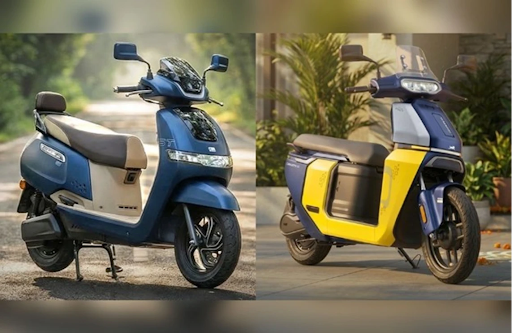
If Delhi’s EV Policy 2.0 is pushing for an electric vehicle switch, TVS Motor has ensured that there is an EV for every budget and use case. Here is a detailed split for buyers looking for an electric scooter in Murka, garhwa.
TVS Orbiter: Best Electric Scooter under ₹1 lakh in Delhi
As a Delhi rider, if you are looking for an affordable EV, the TVS Orbiter is the sweet spot as it eliminates both range anxiety and the entry barrier of a higher price tag.
Price: base variant (V1) starts at an on-road price of ₹82,442*, while the top variant (V2) starts at ₹92,442*.
Advantage: the only EV available to offer an IDC range of 158*, priced under 1 lakh INR. Since it is priced below 1 lakh INR, it is the primary candidate for the Delhi Scrapping incentive. If you swap your old scooter for Orbiter, the effective price drops even further than the listed on-road price.
TVS iQube S: The Reliable Mid-Ranger
This TVS iQube S is on par with or sits higher on specifications than any traditional 110cc-125cc scooter. So, a switch to iQube will not require any habitual change.
Price: iQube 3.1 kWh starts at an on-road price of ₹1,18,536*. The newly launched iQube S, 4.7 kWh, starts at ₹1,50,910*.
Advantage: it is a proven platform in the TVS electric range. Benefiting from the 100% road tax waiver, the on-road price is now significantly affordable.
The new TVS iQube S 4.7 kWh directly eliminates range anxiety with an IDC range of 175* km, with a 7-inch TFT display. TVS has engineered this model to broaden everyday usability without sacrificing the premium tech features.
TVS iQube ST: The Flagship Premium EV
TVS iQube ST is for riders who want no compromise. It gets a 7-inch TFT touch display with 118+ connected features, 32 litres of storage and a big 5.3 kWh battery pack.
Price: on-road price starts at ₹1,83,327*.
Advantage: the massive 5.3 kWh battery pack offers a segment-leading IDC range of 212* km. Moreover, the big battery packs make the TVS iQube ST 5.3 kWh eligible for a full subsidy of ₹30,000, making premium tech more accessible than ever.
Delhi is not asking you to switch; it is making the upgrade irresistible. With 100% road tax exemption, central/state subsidies of up to ₹35,000 and a ₹10,000 scrappage bonus, the era of petrol engines for two-wheelers in New Delhi is on its last lap.
Whether you are a high-mileage user looking for an affordable EV, or a tech enthusiast looking to future-proof your commute with a premium EV scooter, the choice is clear, the incentives are ready, and your spot at the front of the pack is waiting.
Delhi Says Electric. TVS Makes It Easy. Book TVS iQube Now!
Frequently Asked Questions (FAQs)
Q1. How much can I save if I scrap my old scooter for a new TVS Orbiter?
Buyers can save 100% on RTO & registration fees and a direct purchase subsidy based on battery capacity (₹10,000 per kWh in the first year, capped at ₹30,000). In addition to ₹10,000 cash back for a scrappage incentive.
Q2. When will petrol two-wheelers be banned in Delhi and why?
The Delhi EV Policy Draft 2026-2030 proposes a ban on registration of new petrol two-wheelers from April 1st 2028. It intends to combat air pollution and provide a push for green energy/EV adoption.
Q3. What subsidy will I get on electric two-wheelers in Delhi?
Electric two-wheelers with ex-showroom prices up to ₹2.25 lakh are eligible for a subsidy of ₹10,000 per kWh in the first year, capped at ₹30,000 and a ₹10,000 incentive bonus for scrapping old petrol two-wheelers.
For riders in Murka, garhwa, Delhi EV Policy 2.0 creates a strong opportunity to consider an electric scooter while the available incentives, road tax exemption and scrappage benefits can make the transition more affordable. With TVS electric scooters offering options across different price points and use cases, switching to electric mobility can be a practical step towards a cleaner commute.